
Why Choose a Car Perfume Diffuser for Your Vehicle?
A Car Perfume Diffuser can make daily driving feel more comfortable without adding clutter. A light fragrance may soften lingering food or fabric odors, while a compact diffuser can sit neatly near the console. The right choice depends on more than scent. Drivers should consider adjustable intensity, refill availability, ease of cleaning, and whether the device fits securely in their vehicle. Small details matter. A fragrance that feels pleasant in a shop may become overwhelming in a warm, enclosed cabin.
Fragrance expert Luca Turin has written about perfume as a composition of carefully balanced materials. A useful principle for choosing a Car Perfume Diffuser follows from that idea: “A good cabin scent should be noticed gently, not dominate the drive.” This is an editorial summary, not a direct quotation from Turin. It reflects a practical point: subtlety often works better in a small space. Test a low setting on a short trip, then adjust. If the scent causes discomfort, stop using it; personal sensitivity varies.
This guide explores how diffusers work, which features deserve attention, and how to compare common designs. It also considers maintenance and everyday use, including the small annoyance of a refill that runs out sooner than expected. No diffuser can replace cleaning, and fragrance does not remove the source of an odor. Still, a well-chosen device can add a pleasant finishing touch to a clean car.
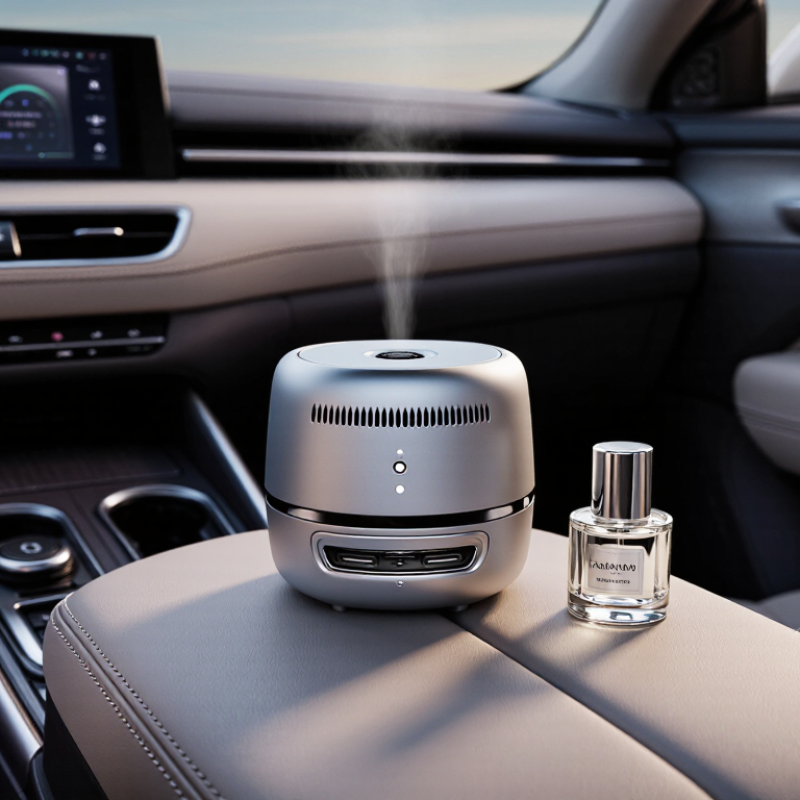
What Is a Car Perfume Diffuser?
A car perfume diffuser is a small device that releases fragrance inside a vehicle. Unlike a paper scent card, it can disperse aroma through airflow, gentle heat, or a replaceable scented insert. Some models clip onto an air vent; others sit in a cup holder. The choice affects how quickly the scent spreads and where it concentrates. A vent-mounted diffuser may feel stronger when the fan is running, then fade when airflow stops.
Its purpose is simple: make a compact cabin smell more pleasant. Yet fragrance adds airborne compounds, so “natural” does not automatically mean irritation-free. The U.S. Environmental Protection Agency notes that indoor VOC concentrations can be two to five times higher than outdoor levels, and sometimes much higher. A parked car is a small enclosed space, though that indoor-air figure should not be treated as a measurement of vehicle cabins. Start with a mild setting, ventilate the car, and stop using the scent if it causes discomfort.
Diffusers vary in control. A passive insert releases scent continuously; an adjustable device may let drivers reduce output. Check that it sits securely and does not block controls or the driver’s view. There is a trade-off: a subtle scent may disappear on a hot afternoon, while a stronger one can become tiring during a long commute. Even careful choices do not suit everyone.
How Does a Car Perfume Diffuser Release Fragrance?
A car perfume diffuser releases fragrance by moving volatile scent molecules from a reservoir into the cabin air. In a vent-mounted model, airflow passes over a scented pad or cartridge and carries the vapour through the grille. A hanging or passive diffuser relies more on evaporation, so warmth from a parked car can make the scent stronger. Small details matter: a sunlit dashboard, a partly open vent, or a nearly empty cartridge can change the fragrance you notice.
Some electronic diffusers use heat or a fan to regulate release, but output varies with settings, cabin temperature, and air circulation. The U.S. Environmental Protection Agency notes that indoor concentrations of some pollutants can be two to five times higher than outdoor levels; this is general indoor-air guidance, not a car-diffuser test. It’s a reason to use fragrance moderately and ventilate the cabin. Less can be enough.
Market context is broad, not proof of product performance: Grand View Research estimated the global air-freshener market at about $12.2 billion in 2022. That figure covers many product types, not only vehicle diffusers. A diffuser offers a controllable scent, but “controlled” is not always “consistent.” Check the refill instructions, keep liquid away from dashboard surfaces, and reduce the setting if the aroma feels sharp or distracting.
What Benefits Can a Car Perfume Diffuser Provide?
Why Choose a Car Perfume Diffuser for Your Vehicle?
What Benefits Can a Car Perfume Diffuser Provide?
A car perfume diffuser can soften stale odors from damp mats, takeaway bags, or a wet coat. A steady, mild scent may make a commute feel more pleasant without masking every smell. That distinction matters: persistent odors can signal spills or moisture that need cleaning, not extra fragrance. A diffuser also gives drivers more control than a strong hanging air freshener, especially when its output can be adjusted.
There is no strong evidence that a car fragrance improves driving skill. The U.S. National Highway Traffic Safety Administration reported 3,308 deaths in distraction-affected crashes in 2022. That figure is not about fragrance, but it supports keeping cabin accessories unobtrusive. Choose a low-intensity scent, secure the diffuser away from controls, and stop using it if it causes discomfort. Fragrances can irritate some people; a pleasant smell for one passenger may be unpleasant for another. I would not treat scent as a substitute for ventilation or cleaning.
Tips: Start with the lowest setting and ventilate the cabin. Keep the device clear of airbags, pedals, and the driver’s direct view. If anyone develops a headache or irritation, switch it off.
What Types of Car Perfume Diffusers Are Available?
Car perfume diffusers come in several practical formats. Vent-clip models attach to an air vent, where moving air spreads the fragrance. They are compact and easy to replace, though scent strength can change with fan speed. Hanging diffusers use a small bottle or scented card. They need no power, but may release fragrance unevenly as the cabin warms. Gel and solid options sit in a cup holder or console. They are simple, but less adjustable.
Electronic diffusers offer more control. Some use heat; others use ultrasonic vibration to disperse scented liquid. Check the refill type, power connection, and cleaning instructions before buying. A loose unit can rattle over bumps.
Small detail, but annoying.
Spray formats provide a quick burst rather than continuous scent, so they suit occasional use. Grand View Research’s air freshener market report estimated the global market at USD 12.1 billion in 2022, with projected growth through 2030. That broad category includes more than automotive products, so it should not be read as car-diffuser sales. In a vehicle, consider cabin size, ventilation, and fragrance sensitivity; strong scent is not always better.
How Can You Choose and Use One Safely?
Why Choose a Car Perfume Diffuser for Your Vehicle?
How Can You Choose and Use One Safely?
Choose a diffuser with adjustable output and a secure mount that will not block your view, airbag, or controls. Check the ingredient and warning labels, and avoid products that trigger headaches, asthma symptoms, or skin irritation. Fragrance is personal; stronger is not better. The US Environmental Protection Agency reports that concentrations of some volatile organic compounds can average two to five times higher indoors than outdoors. That figure is not specific to cars, but it supports using scented products sparingly in a small cabin.
Follow the device instructions, use only its recommended refill, and start with the lowest setting. Keep liquid away from electronics and upholstery, where a spill can leave a stubborn mark. Never place a diffuser where it could become a projectile during sudden braking. Heat matters, too: a 2015 study by researchers at Stanford University and Arizona State University found that parked-car interiors warmed substantially on sunny days, even when outdoor temperatures were moderate. Remove the diffuser before long parking periods if its instructions warn against heat exposure. Open the windows briefly before driving, and stop using the scent if you notice discomfort. I still find “mild” hard to judge; passengers may disagree. Test gently.
| Topic | What to Know | Practical Guidance |
|---|---|---|
| Purpose | A car fragrance diffuser releases scent into the cabin. Depending on its design, it may use passive evaporation, a fan, or a powered mechanism. | Choose a diffuser for fragrance preference and ease of use; it does not remove the underlying cause of odors. |
| Common formats | Common options include vent-mounted diffusers, hanging products, and portable electric diffusers. | Check how the product is secured and whether its placement could obstruct your view or interfere with vehicle controls. |
| Fragrance strength | Perceived scent strength can vary with cabin temperature, airflow, product design, and individual sensitivity. | Start with the lowest available setting or a small amount of fragrance. Reduce use if the scent feels overwhelming. |
| Choosing a product | Products differ in scent, adjustment options, refill requirements, and compatibility with the vehicle’s power source. | Read the label and instructions. Confirm refill compatibility and power requirements before purchase. |
| Placement | A diffuser should be installed only in a position permitted by its instructions and suitable for the vehicle interior. | Keep it away from airbags, pedals, the driver’s line of sight, hot surfaces, and locations where it could become a loose object. |
| Liquid fragrance | Fragrance oils or liquids may damage some plastics, painted surfaces, or upholstery if spilled. | Keep containers upright when required, avoid overfilling, and wipe up spills promptly according to the product instructions. |
| Electrical safety | Powered diffusers may draw power from a vehicle outlet or USB connection, depending on the model. | Use only the specified power source. Disconnect the device when instructed, and stop using it if it becomes unusually hot or damaged. |
| Ventilation | Some people may be sensitive to fragrances, which can cause discomfort or irritation. | Use the diffuser in a well-ventilated cabin. Stop using it if anyone experiences symptoms, and follow relevant product warnings. |
| Cleaning and refills | Residue can build up around a diffuser or its mounting point over time. | Follow the manufacturer’s cleaning and refill instructions, and keep fragrance products out of reach of children and pets. |
| Best practice | A diffuser can add fragrance, but persistent odors may come from sources such as damp materials or accumulated debris. | Clean the cabin and address the odor source first. Use fragrance sparingly, especially when carrying passengers. |
Article Source:


Fall into Function: How LaFata Cabinets Prepares Your Kitchen for the Cozy Season


Back-to-School Kitchen Refresh: How LaFata Cabinets Can Help You Stay Organized This Fall


